
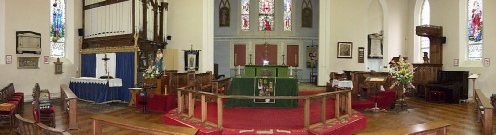
Holy Trinity
Amblecote
The use of colours to differentiate liturgical seasons became a common practice in the Western church in about the fourth century. At first usage varied but by the Twelfth Century Pope Innocent III had systemised the use of five colours. Violet, White, Black, Red and Green. The Lutheran and Anglican churches that emerged from the Reformation retained the traditional colours. To these have been added Blue and Gold, colours that were used in some Western rites before the Twelfth Century. At Holy Trinity we follow a number of traditions which are purely English and are based on the uses found in Hereford and Salisbury in the Middle Ages


Gold or White
These are the festival colours and denote happy times. They are used at Christmas and Easter, on many of the greatest saint's days (except when red is considered more suitable) and on all occasions of great significance to individual Christian people such as Baptism, Confirmation, Weddings or Ordination.


Red is used in three main ways. First, to denote a saint who has died for the faith (the colour of blood spilt in the name of Christ). Second, red is associated with the Holy Spirit (i.e. Whitsun), the Disciples' description of the flames of Pentecost must undoubtedly be the origin of this (we still think of fire engines as red). Third, red is used in association with the spilling of Jesus' own blood for us and is often now the colour used on Good Friday. In some churches, like our own, rich red vestments are used for Martyrs and the Holy Spirit and plain red for Good Friday and Passiontide.

Purple and Black
Purple is used as a sombre colour at times of reflection and preparation for great festivals. Advent (before Christmas) and Lent (before Easter) are two such times. Purple is also the colour associated most with funerals and prayer for the departed. It is often used in preference to black, although we still have black vestments and do use them on occasions.


Sackcloth
The Salisbury tradition of using sackcloth during Lent is followed in our church. The symbolism goes right back to the Jewish custom of putting on sackcloth and pouring ashes over your head as a sign of contrition. Lent is a time when we are encouraged to acknowledge our sins and repent.
Green
It is tempting to say that green is used when no other colour is appropriate. It has a significance of its own in terms of growth, and seems eminently suitable for occasions like Harvest Thanksgiving but it is used on other occasions in the year when one of the other colours is inappropriate.

Blue
Blue has come to be associated with Mary. Whenever she is depicted in stained glass, in statues or paintings, she usually manages to be shown in a blue dress.

This use of colour is part of the Catholic principle of using all our faculties in our worship. What we see about us can speak just as loudly to our hearts and minds as the words we use.
Colours and the seasons of the church year
The Season of Advent
Advent is a season of spiritual preparation for the celebration of the birth and reign of Christ. Expectation rather than personal penitence is the central theme of the season. Advent is a preparation for, rather than a celebration of, Christmas. Royal Purple symbolising the sovereignty of Christ is normally the liturgical colour but Blue is also occasionally used to distinguish the season from Lent. As the colour of the sky, Blue symbolises Christ the source of day. As the colour honouring Mary, Blue also reminds us that during Advent the church waits with Mary for the birth of Jesus.
Christmas and the Christmas Season
The readings for Christmas and the following twelve days, culminating in Epiphany, invite the church to reflect on the Incarnation of God as a human being. God enters human history and identifies fully with the human condition. The traditional colours of the season are White or Gold, symbolizing joy in the light of day.
The Season after Epiphany
The season following Epiphany continues the theme established on Epiphany Day, the spread of the Good News of Christ to all nations on earth. The scripture readings explore the mission of the church in the world. The theme of this season together with the sequence of readings from the Gospel continues in the season after Pentecost, and so both seasons together can be called the "Time of the Church." The traditional liturgical colour is Green, the colour of growth.
The Season of Lent
The traditions of Lent are derived from the time when the church prepared candidates, or "catechumens," for their baptism into the Body of Christ. It eventually became a season of preparation for the whole congregation. Self-
Holy Week
During Holy Week, the congregation follows the footsteps of Jesus from his entry into Jerusalem on Palm Sunday, through the Last Supper of Maundy Thursday to his death on the Cross on Good Friday. Red, the colour of blood and therefore of martyrs, is the traditional colour for Palm or Passion Sunday and the next three days of Holy Week. On Maundy Thursday, White or Gold symbolizes the church's rejoicing in the sacrament of the Lord's Supper. But at the end of the Maundy Thursday celebration, the mood changes abruptly. All decorations are removed and the Holy Table is stripped bare. The church becomes as empty as a tomb. On Good Friday, either Black or Red is customary, although the use of no colour at all is also appropriate.The Red of Holy Week is sometimes a deeper red than the brighter scarlet colour associated with Pentecost.


Easter and Pentecost
Jesus has been raised from the dead. The heavenly messenger invites the mourners to see the empty tomb and then go and tell the disciples that the Crucified One is alive! The season from Easter to Pentecost is also called the Great Fifty Days, a tradition inspired by the Jewish season of fifty days between Passover and Shavuot -
The Season after Pentecost
This longest season of the liturgical year is a continuation of the "Time of the Church" that began on the Sunday after Epiphany. It explores the mission of the church and uses the colour of Green, symbolizing growth.

Other Holy Days and observances
Pentecostal Red is also the traditional colour for Reformation (Martin Luther) Day on October 31st. White or Gold is the colour for All Saints Day on November 1st and is also an alternative to Green on the last Sunday after Pentecost. During other observances, the tradition is to use Red on commemorations of martyrs and other saints. As the colour of the Holy Spirit, it is appropriate for ordinations. The colours of Christmas, White or Gold, are also customary on other feast days that celebrate the Incarnation or Resurrection of Christ (Holy Name, Baptism, Presentation, Annunciation, Visitation, Ascension and Transfiguration). Black for centuries was the traditional colour for funerals, but in the past fifty years many liturgical churches have preferred to use White or Gold—the colours of Easter and therefore of the hope of the Resurrection.
Go to top
