
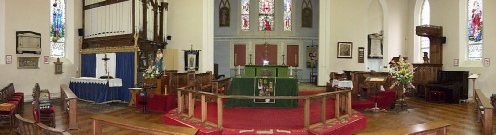
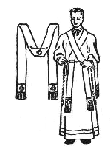
The stole symbolises the clerical office, immortality, and the Yoke of Christ. This, matching the liturgical colour, is a long, scarf-like vestment worn over the alb and under the chasuble. This is presented at Ordination when made a Deacon and worn diagonally across the body. When ordained Priest, the stole is ceremonially untied and from then on worn hanging equally down the chest. A Bishop wears the stole in the same way because he never ceases to be a priest. The origins of the stole are the towels that slaves wore around their necks. When bending down, or kneeling, they would use the towel to wipe the feet of guests or their masters. Jesus wore a towel around his waist and washed the feet of the disciples at the Last Supper. The stole is seen as a symbol that the cleric is to be a servant (slave) to the people of God.
When putting on the stole, the cleric kisses the Cross on the stole and prays: Restore unto me, O Lord, the stole of immortality, which was lost through the guilt of our first parents: and, although I am unworthy to approach Your sacred Mysteries, nevertheless grant unto me eternal joy.
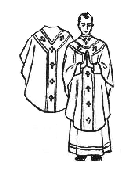
The chasuble symbolises charity and the Yoke of Christ. This matches the liturgical colour and is a long, often ornate, sleeveless poncho-like garment worn by priests and bishops over the alb and stole during the sacrifice of the Mass.
As he puts on the chasuble he prays: O Lord, who said: My yoke is easy and my burden light: grant that I may bear it well and follow after you with thanksgiving. Amen.
The Cope Worn by the Priest or Deacon for non-Eucharistic Liturgy the cope is a large mantle worn by clerics at some liturgical celebrations, but not at the Mass. It can be worn, for example, during processions and benedictions of the Blessed Sacrament, at funerals and at weddings. It matches the colour of the liturgy and is worn in the same way as the chasuble.
The Cassock The black cassock worn by most Priests in many different situations is of no special significance other than as a means of identification. Part of its significance is that it covers up and, to some extent, hides the individualism of the Priest and proclaims to all that he is a Priest of the Church.
Liturgical Vestments
The robes worn for the Eucharist are an adaptation of the ordinary clothes worn at the time of the Roman Empire. When those clothes were no longer worn everyday priests continued to wear them. These clothes tended to be left in Church and simply put on for services. This happened over time and it is almost by accident that they have come to be associated with priesthood and the Eucharist.
When vesting for the liturgy the priest first washes his hands, praying: Give virtue to my hands, O Lord, that being cleansed from all stain I might serve you with purity of mind and body.
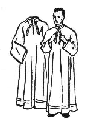
The alb is the long white, robe-like vestment worn by all clerics at liturgical celebrations (celebrant, concelebrant, deacon or acolyte). White is the symbol of purity and the term alb, from the Latin word albe, means white. It can be traced to the Roman alb worn under a cloak or tunic.
The cleric prays: Purify me, O Lord, and cleanse my heart, that being made white in the Blood of the Lamb, I may come to eternal joy.
The girdle which is a symbol of chastity, ties the alb at the waist.
The cleric prays: Gird me, O Lord, with the girdle of purity, and extinguish in me all evil desires, that the virtue of chastity may abide in me.
 Go to top
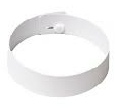
The Collar The distinctive collar worn by most clergy is known by a number of names Clerical, Roman or Dog being the best. It closes at the back of the neck, presenting a seamless front. The shirt may have the collar built in. The clerical collar is almost always white and was originally made of cotton or linen but is now frequently made of plastic. It is claimed that although called a Roman collar it was a protestant invention of the late nineteenth Century.
The person credited for the introduction of the detachable white collar was the Reverend Donald McLeod, a Church of Scotland or Presbyterian minister, in Glasgow in 1865. He combined this with the white preaching bands which had been worn by Protestant Clergy for some time.
There has been some discussion of late concerning the wisdom of the clergy wearing such a distinctive form of dress. Vicars have been told to stop wearing dog-collars because they increase the likelihood of them being attacked.
A report called ‘The Clergy Lifestyle Theory’ published in 2007 warned clergy that the collars make them an "easy target" and says they should adopt more casual clothing in a bid to give them greater safety.
The report caused some controversy amongst the Clergy with the claim that “many feel torn when it comes to balancing the desire to be visible and approachable within their community against the importance of protecting their safety and personal time”.
Canon Paul Tongue’s booklet ‘Why?’ may prove helpful in explaining the reasons for the use of Vestments.
Why?
